There is something beautiful about a beginning that is truly new. In the Christian life, that beginning comes through Baptism. This sacrament is not simply a religious tradition, a family celebration, or a public symbol. It is the moment a person is washed clean from sin, reborn as a child of God, and welcomed into the Church. It is the starting point of life in Christ, the foundation on which everything else is built (Catechism of the Catholic Church [CCC], 1994, para. 1213).
When Jesus spoke with Nicodemus, He made it clear that this new life comes through water and the Spirit: “Unless one is born of water and the Spirit, he cannot enter the kingdom of God” (John 3:5, New American Bible Revised Edition). From the earliest days of Christianity, the Church has understood these words as pointing to the necessity of this sacrament as the ordinary means by which a person enters the life of grace (CCC, 1994, para. 1257).
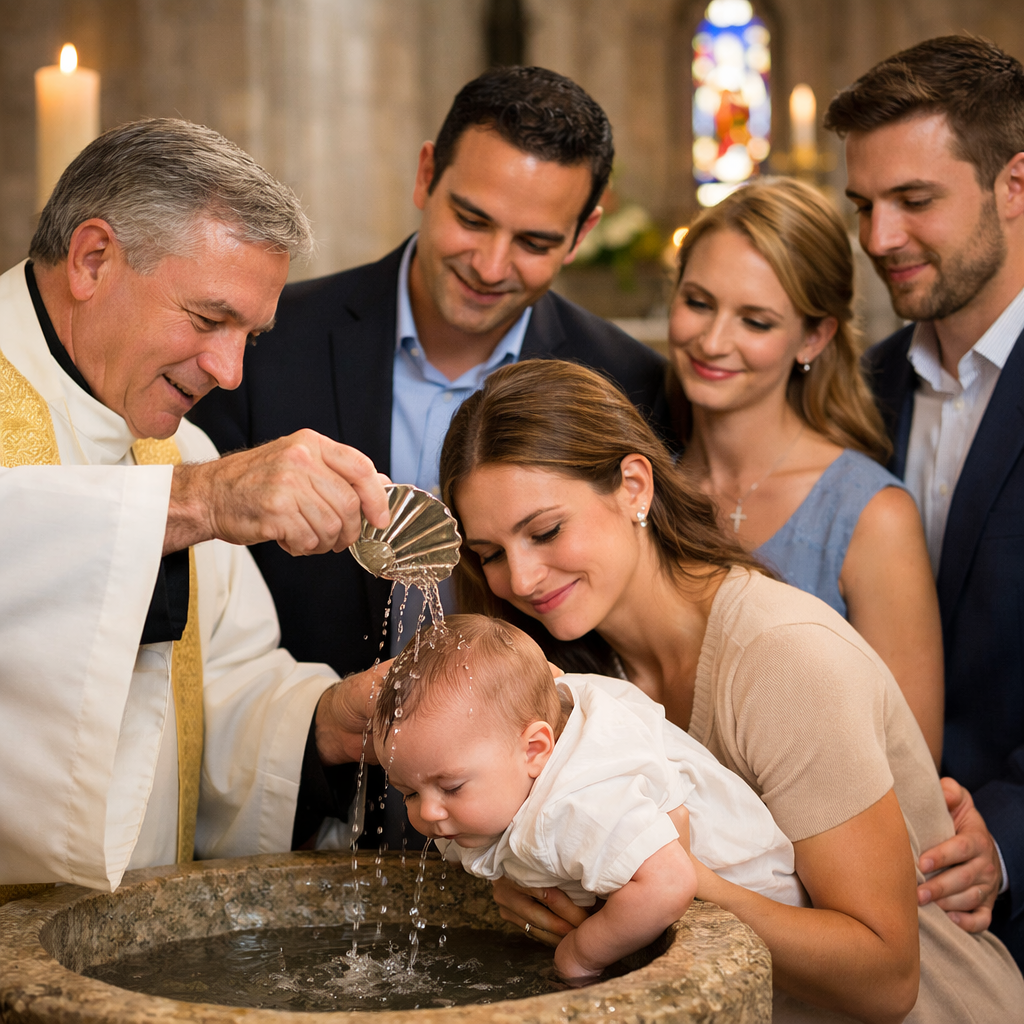
The outward action is simple. Water is poured over the head, or the person is immersed, while the name of the Father, the Son, and the Holy Spirit is spoken (CCC, 1994, para. 1278). Yet behind that simplicity is a deep spiritual mystery. Throughout Scripture, water carries the meaning of cleansing, life, danger, death, and renewal. In this sacred rite, all of those meanings meet. The old life marked by sin is left behind, and a new one begins in union with Christ. Saint Paul describes this as being buried with the Lord and raised with Him into a new way of living (Rom. 6:3–4; CCC, 1994, para. 1227).
One of the greatest gifts received in this moment is forgiveness. Original sin is taken away, and for adults, every personal sin is also removed. Even the punishment due to sin is washed away by God’s mercy (CCC, 1994, para. 1263). That means the soul is made clean before Him. Nothing remains that would stand between the newly initiated Christian and the love of God.
But this sacrament is not only about cleansing. It is also about becoming. Through this new birth, a person becomes a new creation, an adopted son or daughter of the Father, a member of Christ, and a temple of the Holy Spirit (CCC, 1994, para. 1265). Grace is poured into the soul, along with the virtues of faith, hope, and charity, and the gifts needed to begin walking with God in a new way (CCC, 1994, para. 1266). What starts here is not merely a moral improvement. It is a supernatural life.
This new beginning is also an entrance into a family. Christian faith was never meant to be lived in isolation. Through this sacrament, a believer is joined to the Church, the Body of Christ, and becomes part of the communion of the faithful (CCC, 1994, para. 1267). That means the newly baptized does not just belong to Jesus in a private way. He also belongs to Christ’s people. He shares in the worship, mission, and life of the Church and is invited to grow within that living community of faith (CCC, 1994, paras. 1267–1269).
Another important truth is that this sacrament leaves a permanent spiritual mark. That mark, called a sacramental character, can never be erased (CCC, 1994, para. 1272). Because of that, it is received only once. Even if someone later wanders far from the Lord, the seal remains. It stands as an enduring sign that the person belongs to Christ and is always being called home.
There is also a purpose given here. New life in Christ is never meant to stay hidden. Those who receive this grace share in the common priesthood of the faithful and are called to live their faith openly, faithfully, and lovingly in the world (CCC, 1994, paras. 1268, 1270). This is why the sacrament is not just a past event to remember. It is the beginning of a lifelong calling. The grace given at the font is meant to bear fruit in prayer, worship, service, and witness.
The Church’s practice of welcoming infants into this grace shows something important about God’s love. He does not wait for a person to earn His favor. He gives freely. Little children are brought for this new birth because they too need freedom from original sin and the gift of divine life (CCC, 1994, para. 1250). In adults, this grace follows a personal response of faith and conversion. In infants, it is planted first and then nurtured through family life, Christian formation, and the care of the Church (CCC, 1994, paras. 1231, 1254). In both cases, the message is the same: grace comes first.
This changes how Christians see themselves. A believer is no longer defined only by weakness, past mistakes, or the labels the world gives. He has been washed, sanctified, and justified in Christ. He has been reborn by water and the Spirit, brought into the Church, and marked forever as belonging to the Lord (CCC, 1994, paras. 1213, 1262–1274). That is why this sacrament matters so deeply. God does not merely adjust a life a little. He makes all things new.
In the end, this is the sacrament of beginnings. It is the doorway into the Christian life, the foundation of identity in Christ, and the entrance into the family of God. Through it, sin is forgiven, grace is poured out, and a new life begins. To receive this gift is to be born into hope, welcomed into the Church, and claimed forever by the love of God.
References
Catechism of the Catholic Church. (1994). Catechism of the Catholic Church (2nd ed.). United States Catholic Conference.
The Holy Bible, New American Bible Revised Edition. (2011). Confraternity of Christian Doctrine.