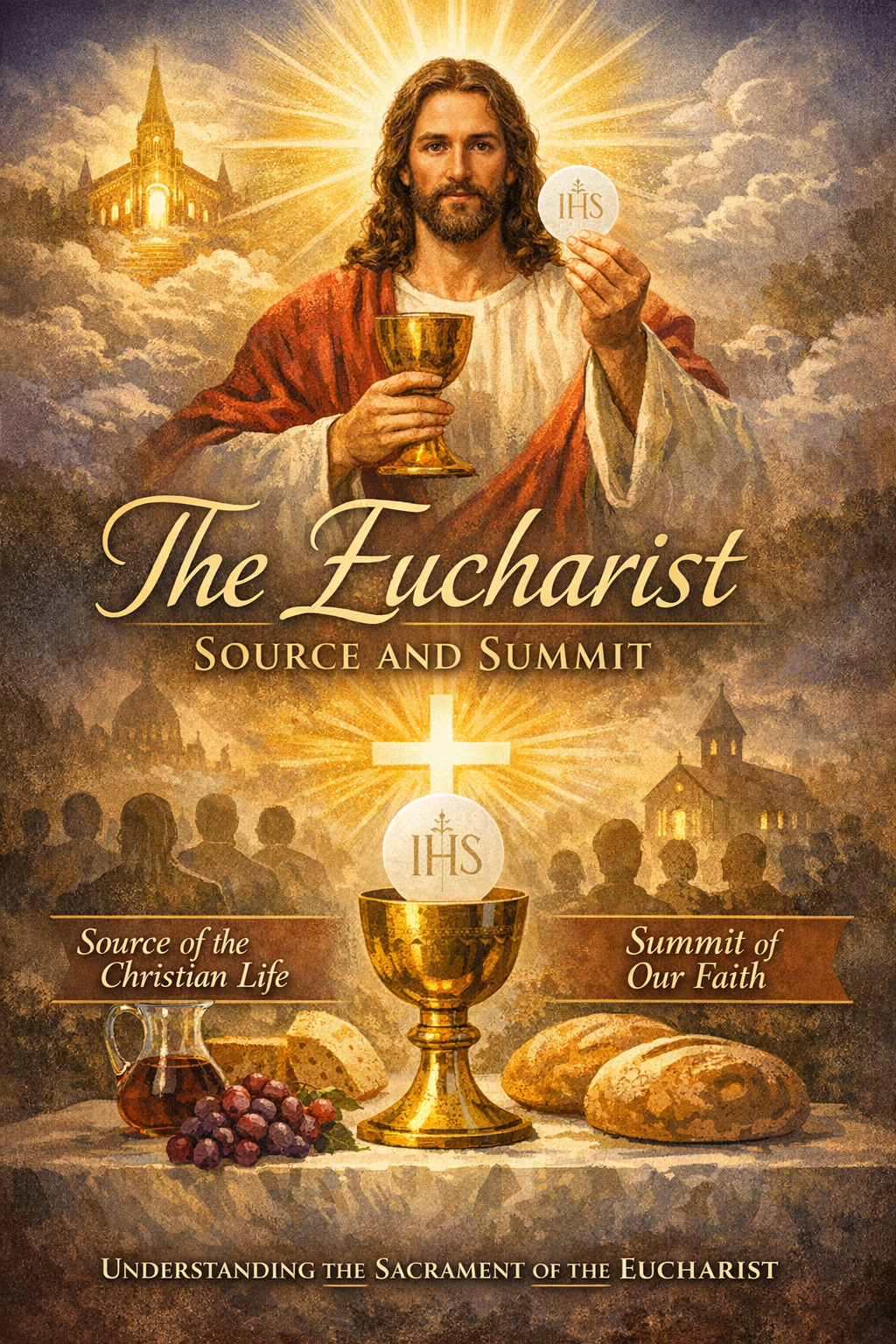
There are few phrases in Catholic teaching as rich and beautiful as this one: the Eucharist is the source and summit of the Christian life. In those words, the Church reveals something essential. The Eucharist is not simply one devotion among many, nor is it only a sacred reminder of Christ. It is the living gift of Christ Himself, given for the life of the world. It is the source because grace flows from it, and it is the summit because the whole Christian life is meant to lead us into communion with God.
At every Mass, heaven touches earth. The Church gathers, the Word of God is proclaimed, bread and wine are offered, and by the power of the Holy Spirit, they become the Body and Blood of Jesus Christ. The Eucharist stands at the heart of Catholic worship because it makes present the saving sacrifice of Christ and unites the faithful with Him in a deeply personal and communal way.
What Is the Eucharist?
The word Eucharist means thanksgiving. That meaning matters because in this sacrament, the Church gives thanks to the Father for creation, redemption, and sanctification. Yet the Eucharist is more than an act of gratitude. It is also the Holy Sacrifice of the Mass, the Lord’s Supper, the Breaking of the Bread, Holy Communion, and the Blessed Sacrament.
Each of these names reveals part of the mystery. The Eucharist is a sacred meal, a true sacrifice, a memorial of Christ’s Passion, a communion in His life, and the abiding presence of the risen Lord among His people.
Given to the Church by Christ
The Eucharist comes directly from Jesus Himself. At the Last Supper, on the night before He suffered, He took bread and wine and gave them to His disciples, saying, “This is my body” and “This is my blood.” In doing so, He gave the Church this sacrament as a lasting gift and commanded His followers to continue this sacred memorial in His name.
The Last Supper cannot be separated from Calvary. What Jesus offered sacramentally in the Upper Room, He offered visibly on the Cross. At every Mass, the Church does not repeat His sacrifice, but enters into its saving mystery. The one sacrifice of Christ is made present sacramentally, so that believers in every age may share in its grace.
The Real Presence of Christ
One of the central truths of Catholic faith is that Jesus Christ is truly, really, and substantially present in the Eucharist. After the consecration at Mass, the bread and wine are no longer merely bread and wine in their deepest reality. Though their outward appearance remains the same, they become the Body and Blood of Christ.
This is why Catholics approach the Eucharist with reverence and awe. The Church does not teach that Holy Communion is only symbolic. Rather, under the appearances of bread and wine, the faithful receive Christ Himself—Body, Blood, Soul, and Divinity. This truth is at the center of Catholic Eucharistic faith and devotion.
Because Christ is truly present, the Blessed Sacrament is adored, reserved in the tabernacle, and honored with deep love. The Eucharist is not merely something received. This is Christ encountered.
Why the Eucharist Is the Source
The Eucharist is called the source of the Christian life because it nourishes the soul with divine life. In this sacrament, Christ does not simply give strength from afar. He gives Himself. The grace poured out in the Eucharist deepens our union with Him, strengthens charity, and renews the life of grace first received in Baptism.
Holy Communion helps heal the wounds of sin, strengthens us against future temptation, and binds us more closely to the Church. It is spiritual food for the journey of faith. Without this nourishment, the Christian life grows weak. With it, the believer is sustained, renewed, and drawn more deeply into the mystery of Christ.
Why the Eucharist Is the Summit
The Eucharist is also the summit of the Christian life because everything in the life of the Church is ordered toward communion with God. Prayer, repentance, acts of charity, Scripture, and the other sacraments all lead toward deeper union with Christ. In Holy Communion, that union reaches its highest expression on earth.
The Mass is the high point of the Church’s worship because it joins the faithful to Christ’s perfect offering to the Father. It is also a foretaste of heaven, a glimpse of the eternal banquet where God’s people will rejoice in His presence forever. The Eucharist feeds us for the journey, but it also points us toward our final home.
The Eucharist Builds the Church
The Eucharist is not only a personal gift. It is also the sacrament that builds up the Church. The faithful do not come forward as isolated individuals. They come as members of the Body of Christ. Sharing in one bread and one cup, the Church is strengthened in unity, charity, and mission.
This means that devotion to the Eucharist should shape the way we live. Receiving Christ in Holy Communion should deepen love for neighbor, especially for the poor, the forgotten, and the suffering. The one who receives the Body of Christ is called to recognize Christ in others and to serve with humility and mercy.
Preparing Our Hearts
Because the Eucharist is such a sacred gift, the Church calls the faithful to prepare well before receiving Holy Communion. That preparation includes faith in Christ’s presence, freedom from mortal sin, reverence, prayer, and the Eucharistic fast.
This preparation is not about pretending to be perfect. It is about coming with humility, repentance, and faith. The more we understand who it is we receive, the more our hearts are moved to gratitude and love. Christ comes to strengthen the weak, forgive the repentant, and nourish those who long for Him.
Living a Eucharistic Life
The Eucharist is meant to shape daily life. What we celebrate at the altar should transform how we speak, forgive, serve, and love. The self-giving of Christ becomes the pattern for the Christian’s self-giving.
To live a Eucharistic life is to become a person of thanksgiving, charity, and trust. It is to let the grace of the Mass continue long after the final blessing. The faithful are not only invited to receive Christ but also to carry His presence into the world through lives marked by holiness and love.
Final Reflection
The Eucharist stands at the center of Catholic life because Christ stands at its center. In this sacrament, He gives not merely a reminder of Himself, but His very Self. He feeds His people, renews His covenant, gathers His Church, and draws heaven near.
To call the Eucharist the source and summit is to recognize that everything begins in Christ and returns to Him. From the altar, grace is poured out. At the altar, the Church offers her highest worship. And through the Eucharist, believers are drawn ever more deeply into the mystery of divine love.
Here is our treasure. Here is our strength. Here is our Lord.
Catechism References
- CCC 1322–1327 — The Holy Eucharist in the economy of salvation
- CCC 1324–1325 — Source and summit of the Christian life
- CCC 1328–1332 — Names of this sacrament
- CCC 1337–1344 — Institution of the Eucharist
- CCC 1373–1381 — Christ’s presence in the Eucharist
- CCC 1391–1401 — Fruits of Holy Communion