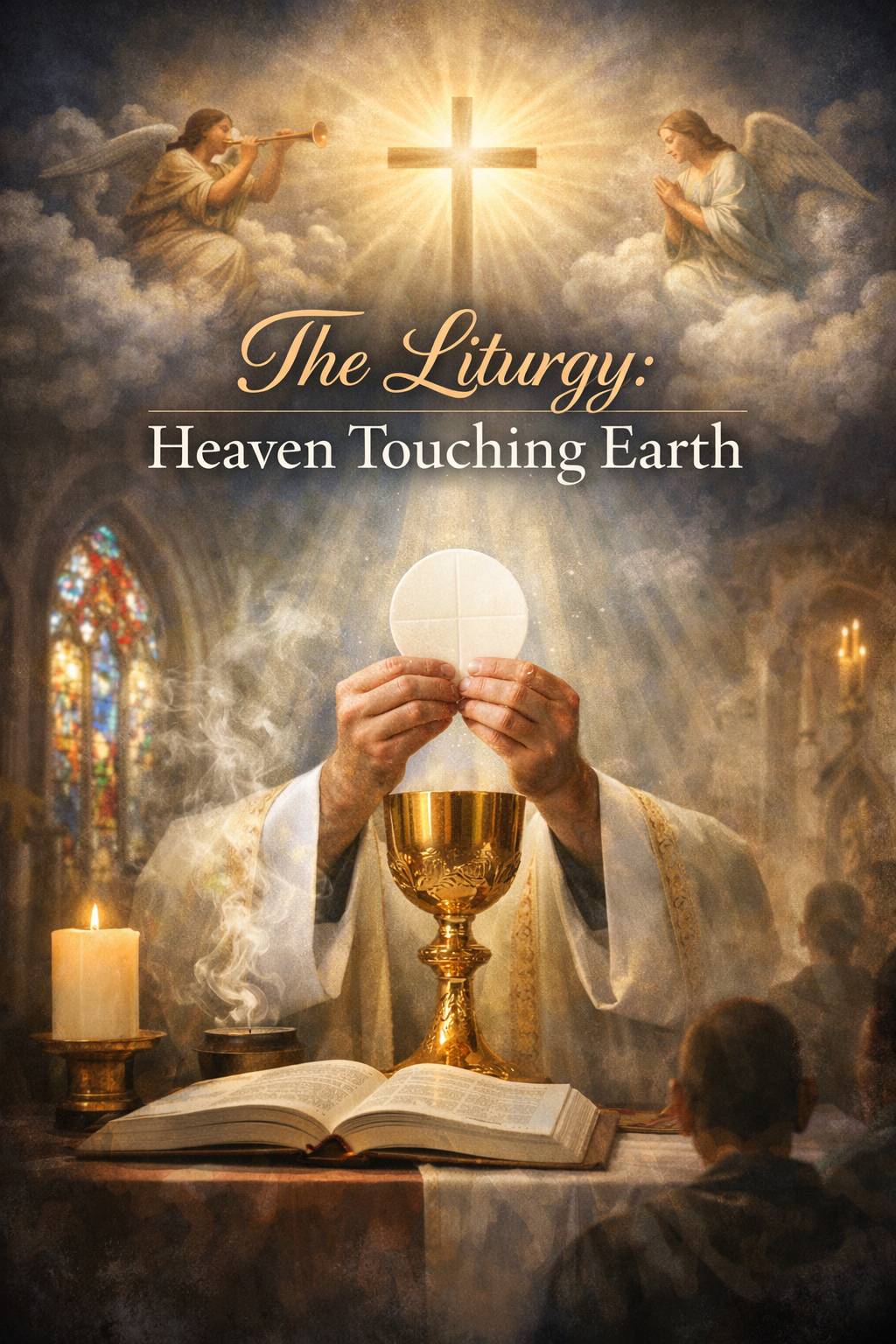
The liturgy is where the mystery of Christ becomes present to us. It is not merely a set of rituals or traditions, but the living action of Christ and His Church. In the liturgy, heaven and earth meet, and God invites His people to share in His saving work.
The Catechism teaches that the liturgy is “the participation of the People of God in the work of God” (CCC 1069). Through visible signs and sacred actions, God communicates invisible grace. What Christ accomplished once for all through His death and resurrection is made present again in the Church’s worship.
What Is the Liturgy?
The word liturgy comes from a Greek term meaning “public work” or “service on behalf of the people.” In the Christian sense, it refers to the official worship of the Church. This includes the Mass, the sacraments, and the liturgical seasons that shape the rhythm of Christian life.
In the liturgy:
- Christ is the principal actor
- The Church participates as His Body
- The Holy Spirit makes Christ’s saving work present
The liturgy is not something we invent or control. It is received from the Church and handed on through tradition, ensuring unity across time and place.
The Liturgy as the Work of the Trinity
Every liturgical celebration is Trinitarian in nature.
- The Father is the source of all blessing and grace
- The Son accomplishes salvation through His Paschal Mystery
- The Holy Spirit makes that saving work present and effective today
When the Church celebrates the liturgy, she enters into the eternal exchange of love within the Trinity. Worship is not only directed toward God; it is also God acting for the salvation of His people.
Signs, Symbols, and Sacred Time
God uses ordinary realities to communicate extraordinary grace. Water, bread, wine, oil, words, gestures, and silence all become instruments of divine action in the liturgy.
Liturgical time also shapes how believers experience salvation:
- Sunday recalls the Resurrection
- Seasons such as Advent, Lent, and Easter draw believers into the life of Christ
- Feasts and solemnities highlight key moments in salvation history
Through these rhythms, the Church learns to see time itself as redeemed.
Why the Liturgy Matters
The liturgy is not optional or secondary to Christian life. It is essential because:
- It forms believers in faith and prayer
- It unites the Church across cultures and generations
- It prepares Christians to live the Gospel in daily life
What is celebrated at the altar is meant to be lived in the world. The liturgy sends believers forth to become witnesses of Christ’s love and mercy.
Looking Ahead
This post introduces the foundation of Pillar II. The next posts will explore how the mystery of Christ is celebrated specifically through the seven sacraments, beginning with Baptism and continuing through the sacraments of initiation, healing, and service.
Reflection Question
How does participating in the liturgy shape the way you see God, the Church, and your daily life?
Closing Prayer
Lord God,
You draw us into Your saving work through the sacred liturgy.
Open our hearts to recognize Your presence
in the prayers, signs, and actions of the Church.
May what we celebrate in worship
shape how we live each day,
so that our lives reflect the grace
we receive at Your altar.
We ask this through Christ our Lord.
Amen.