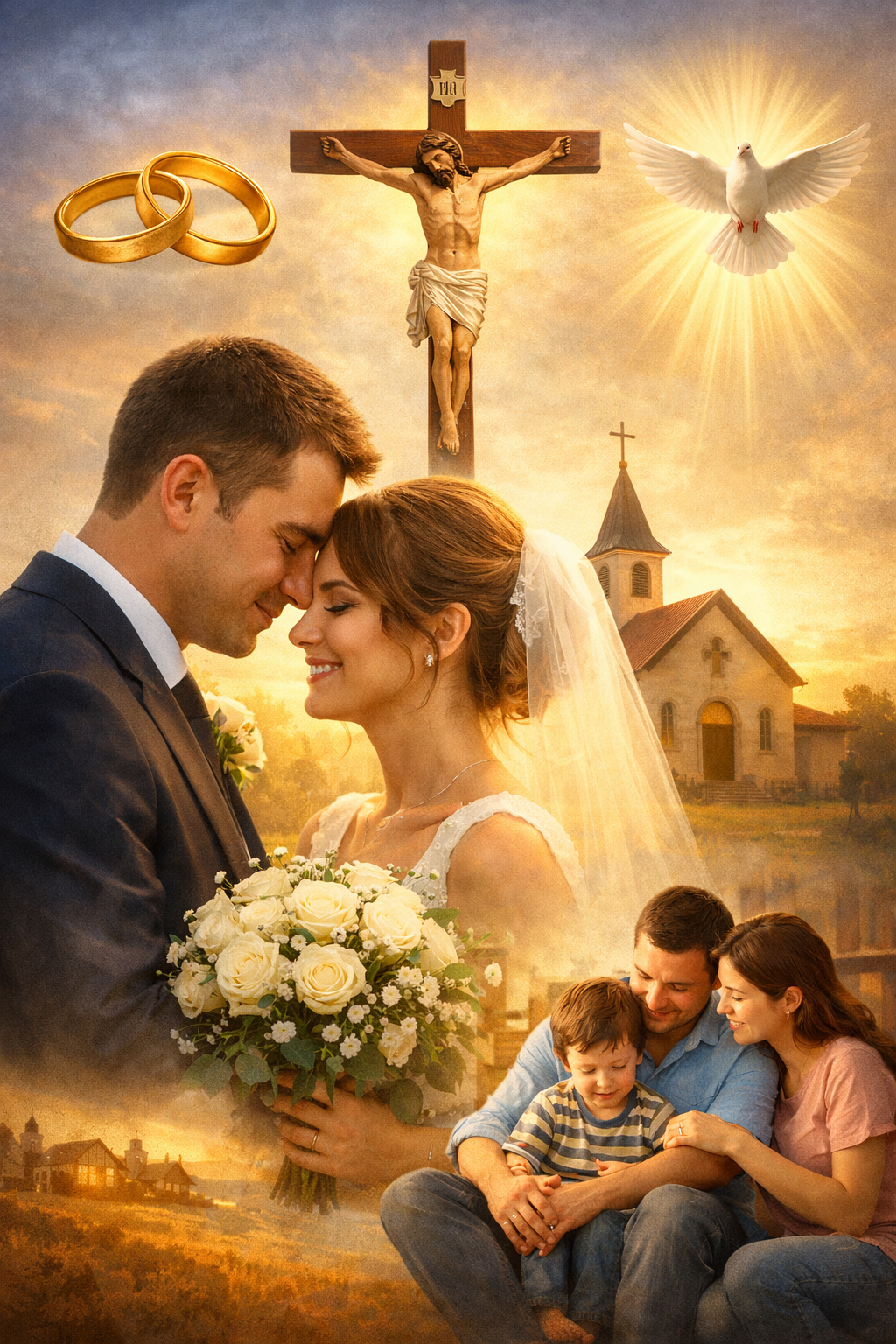
Marriage is far more than a legal contract or a cultural tradition. In the Catholic faith, Matrimony is a sacred covenant established by God and elevated by Christ to the dignity of a sacrament. Through this union, a man and a woman are joined in faithful love and given grace to live their vocation together. Christian marriage is not simply about companionship. It is a path of holiness, a witness to Christ’s love, and the foundation of what the Church calls the domestic church.
Marriage in God’s Loving Plan
From the beginning, marriage was part of God’s design for humanity. Sacred Scripture presents man and woman as created for each other, called into a communion of life and love. Their union reflects both the dignity of the human person and the wisdom of the Creator.
The Church teaches that marriage is ordered toward two inseparable purposes: the good of the spouses and the gift of new life. In marriage, husband and wife are called to support one another, grow in virtue together, and cooperate with God in the creation and raising of children. This vocation is not accidental. It is part of the very structure of creation and is fulfilled in the grace of Christ.
The Reality of Sin and the Need for Grace
Although marriage is part of God’s good plan, human love has been wounded by sin. Selfishness, pride, unfaithfulness, and the desire to control rather than serve can damage the unity God intended between husband and wife.
This is one reason the sacrament of Matrimony is so important. God does not leave married couples to rely only on human strength. He gives sacramental grace to sustain them in fidelity, patience, forgiveness, and perseverance. That grace is not abstract. It helps couples love one another not only in joyful times, but also in moments of suffering, sacrifice, and trial.
Christian marriage does not ignore the hardships of life. Instead, it invites spouses to face them together with Christ at the center.
The Beauty and Demands of Conjugal Love
The love of husband and wife is meant to be total, faithful, fruitful, and permanent. These qualities reveal the beauty and seriousness of the marriage covenant.
- Total love means spouses give themselves fully to one another, not partially or conditionally.
- Faithful love means that marriage calls for exclusive and lasting commitment. Husband and wife promise to remain true to one another in good times and in bad.
- Fruitful love means that marriage is naturally open to life. Children are a blessing and a living sign of the generosity of marital love.
- Permanent love means that the covenant of marriage is meant to endure. It is a lifelong bond, not a temporary arrangement.
These demands can seem challenging in a culture that often treats commitment as flexible and love as fleeting. Yet the permanence and faithfulness of Christian marriage are not burdens placed on love. They are protections that allow love to deepen, mature, and reflect the faithfulness of God Himself.
Matrimony as a Sacrament
Christ raised marriage between baptized persons to the level of a sacrament. This means that Christian marriage is a visible sign of invisible grace. It not only symbolizes Christ’s love for the Church but also makes that grace present in the couple’s life.
The spouses themselves, through their free consent, become ministers of the sacrament to one another. Their vows establish a covenant before God and the Church. That covenant forms a real and lasting bond, strengthened by divine grace.
Because of this sacramental reality, marriage is more than a private relationship. It belongs to the life of the Church. The love of a husband and wife becomes a witness to the Gospel. Their fidelity reflects Christ’s unwavering love. Their sacrifices mirror His self-giving. Their shared life becomes a sign to the world that covenant love is possible.
The Family as the Domestic Church
The Church calls the family the domestic church because the home is the first place where the faith is lived, taught, and handed on. It is within family life that children often first learn to pray, forgive, trust, and love.
Parents have a sacred mission in this calling. They are the primary educators of their children in the faith. Their example often teaches more powerfully than words alone. A child who sees parents pray, forgive one another, serve generously, and remain faithful receives a living lesson in Christian discipleship.
The domestic church is not built on perfection. It is built on daily faithfulness. A family becomes a domestic church when Christ is welcomed into ordinary life: at the dinner table, in times of prayer, in acts of mercy, in patient endurance, and in the quiet sacrifices made for one another.
Even amid weakness and struggle, the Christian home can become a place where the presence of God is known and the love of Christ is made visible.
A Needed Witness in the Modern World
In today’s world, marriage and family life often face confusion, pressure, and instability. That is why faithful Christian homes matter so much. They offer a witness that love is more than emotion, freedom is more than self-assertion, and commitment is more than convenience.
When spouses remain faithful, forgive one another, pray together, and persevere through hardships, they proclaim something powerful. They show that grace is real. They show that covenant love can endure. They show that Christ is still present in the ordinary and hidden places of life.
This witness is not only for the Church. It is also for the world. The domestic church becomes a light when it reflects God’s love through daily acts of faith, hope, and charity.
Conclusion
Matrimony is a covenant rooted in creation, redeemed by Christ, and sustained by grace. It is a sacrament that calls husband and wife into a communion of faithful, fruitful, and enduring love. From that union grows the family, the domestic church, where faith is first lived and shared.
In a Christian home, daily life becomes holy ground. Love is strengthened by sacrifice. Faith is passed from one generation to the next. And the world is given a quiet but powerful witness of God’s covenant love.
References
Catholic Church. (1994). Catechism of the Catholic Church (2nd ed.). United States Catholic Conference.
Francis. (2016). Amoris laetitia. Libreria Editrice Vaticana.
John Paul II. (1981). Familiaris consortio. Libreria Editrice Vaticana.
United States Conference of Catholic Bishops. (n.d.). New American Bible, Revised Edition.