Confirmation is often seen as a milestone, but the Church teaches that it is far more than a ceremony or tradition. It is a sacrament of grace in which the baptized are sealed with the Holy Spirit and strengthened to live as faithful witnesses of Jesus Christ. Along with Baptism and the Eucharist, Confirmation belongs to the sacraments of Christian initiation and brings baptismal grace to completion.
More Than a Milestone
Many Catholics receive Confirmation during their teenage years, so it can be easy to think of it as a kind of graduation in the life of faith. But Confirmation is not the end of formation. It is a new source of strength for the Christian life.
The sacrament recalls the outpouring of the Holy Spirit at Pentecost. The same Spirit who transformed the apostles from fearful followers into bold witnesses is given to the faithful in Confirmation. God does not begin His work in us and then leave it unfinished. He strengthens, confirms, and sends His people into the world.
The Seal of the Spirit
One of the most meaningful images connected to Confirmation is the seal. In this sacrament, the Christian receives the mark of the Holy Spirit. This seal signifies belonging to Christ, being marked as His own, and being entrusted with His mission.
This mark is permanent. Confirmation imprints an indelible sacramental character on the soul and can only be received once. In a world where identity can feel unstable and uncertain, Confirmation reminds us that our deepest identity is not something we invent. It is received from God. We belong to Christ.
What Confirmation Does
Confirmation is not only symbolic. The Catechism teaches that it brings real spiritual effects. It deepens baptismal grace, roots us more firmly in divine sonship, unites us more closely to Christ, increases the gifts of the Holy Spirit, strengthens our bond with the Church, and gives us special strength to spread and defend the faith.
That grace matters in daily life. It helps believers remain faithful in difficult times, speak the truth with charity, resist sin, and live openly as disciples of Jesus. The courage given in Confirmation is not only for dramatic moments. It is also for ordinary faithfulness.
The Signs of the Sacrament
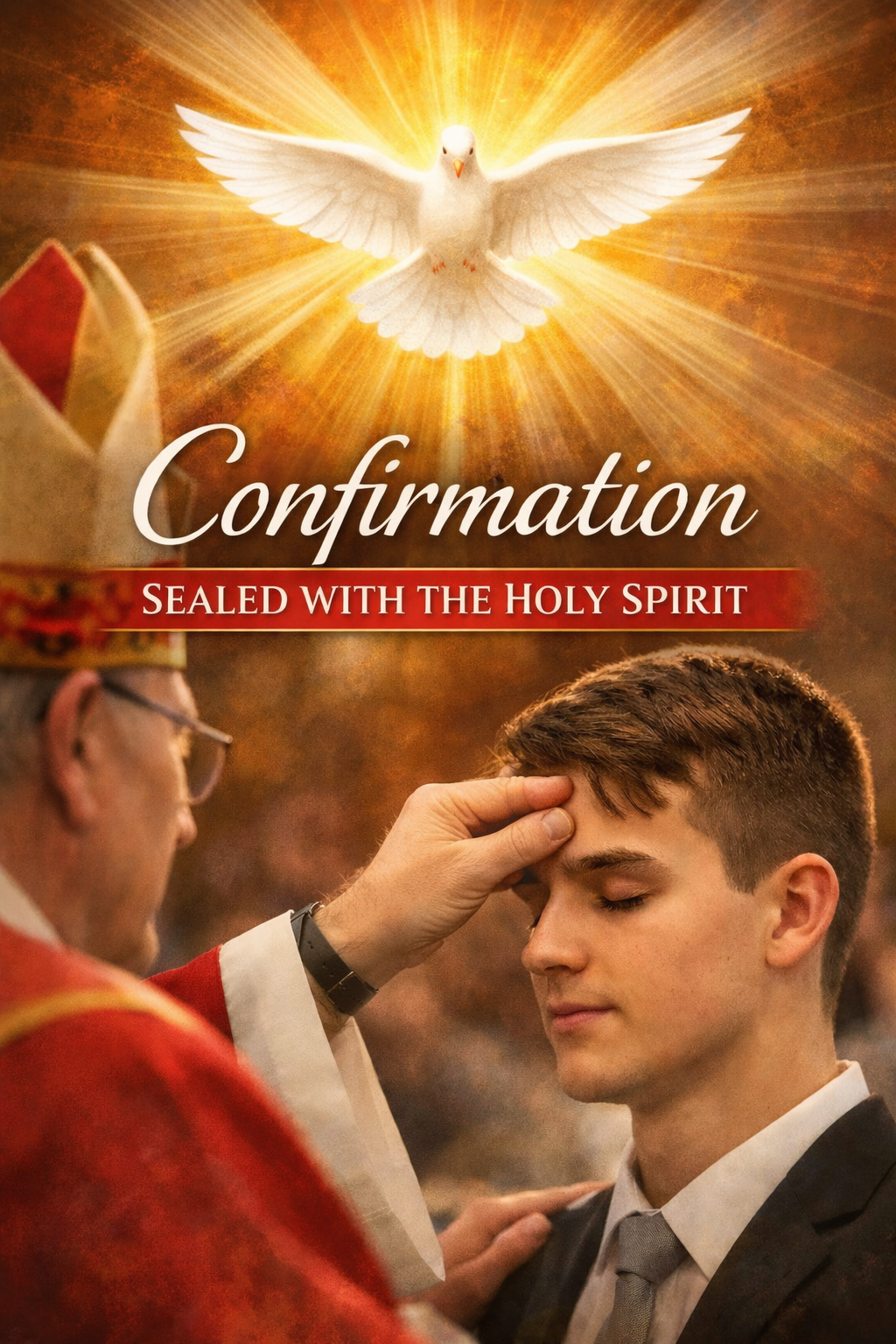
The essential signs of Confirmation are the laying on of hands and the anointing with sacred chrism. In the Latin Church, the minister anoints the forehead and says, “Be sealed with the Gift of the Holy Spirit.”
Anointing carries deep biblical meaning. In Scripture, kings, priests, and prophets were anointed for a mission. Jesus is the Anointed One, the Christ. Through Confirmation, Christians are consecrated more fully to share in His life and mission.
Strengthened for Witness
The Holy Spirit is given so that grace does not remain hidden. Confirmation strengthens believers to bear witness to Christ in the world.
For some, that witness may be public and visible. For others, it may look like daily perseverance, honesty, kindness, sacrifice, and fidelity to the Gospel in ordinary life. A parent passing on the faith, a student refusing to hide belief, or a worker choosing integrity over compromise all reflect the strength of the Spirit at work.
Confirmation calls every Catholic to live a faith that is not private and silent, but real, visible, and grounded in Christ.
A Sacrament of the Church
Confirmation also deepens our bond with the Church. In the Latin tradition, the bishop is the ordinary minister of Confirmation, which highlights the connection between the confirmed and the apostolic Church. Even when a priest administers the sacrament, that larger bond remains.
The Holy Spirit does not seal us into isolation. He draws us into deeper communion with the Body of Christ. Confirmation strengthens personal faith, but it also places us more firmly within the life and mission of the Church.
Living the Grace of Confirmation
For those who have already received this sacrament, Confirmation should not be treated as a memory from the past. Its grace remains. The seal remains. The call remains.
It is worth asking: Am I living as someone strengthened by the Holy Spirit? Do I call on the Spirit for wisdom, courage, and perseverance? Am I willing to be known as a follower of Christ?
Confirmation is a living grace meant to bear fruit. It is meant to shape prayer, service, witness, and love.
Final Thought
Confirmation is a gift of God’s strength for the Christian life. It completes baptismal grace, seals the believer with the Holy Spirit, and equips the faithful to live boldly for Christ.
To be confirmed is to be marked as belonging to Jesus, strengthened by His Spirit, and sent into the world with purpose. The Holy Spirit is not distant. He is the gift of God poured into the hearts of believers, helping them live with courage, faith, and hope.
References
Catechism of the Catholic Church. (1993). The sacrament of Confirmation (pars. 1285–1321). Holy See.
Catechism of the Catholic Church. (1993). The effects of Confirmation (pars. 1302–1305). Holy See.
Catechism of the Catholic Church. (1993). The signs and the rite of Confirmation (pars. 1293–1301). Holy See.
Catechism of the Catholic Church. (1993). In brief: Confirmation (pars. 1315–1321). Holy See.
Compendium of the Catechism of the Catholic Church. (2005). Questions 266–270. Holy See.